
Published on: 7 September 2026
Caravan Salon Düsseldorf has wrapped up for another year, offering an interesting glimpse at where the global RV industry might be heading next.
Among the new models and concepts unveiled for 2026 were everything from Australian-built off-road caravans making their European debut to an electric motorhome built from the ground up, a caravan that expands at the touch of a button and a $3.5 million motorhome with room in the back for a Porsche 911.
Look beyond the individual launches, though, and some bigger themes start to emerge. Some manufacturers are trying to make RVs lighter, smaller and more practical for everyday life. Others are pushing further into off-grid capability and sophisticated expedition travel. And at the very top end, it seems there really is no limit to how luxurious an RV can become.
Here are seven trends from Caravan Salon Düsseldorf 2026 that caught our attention, and why they’re worth watching from Australia.
We’ll start with Australia, because two of the more extreme off-road caravans highlighted at Düsseldorf came from our own backyard.
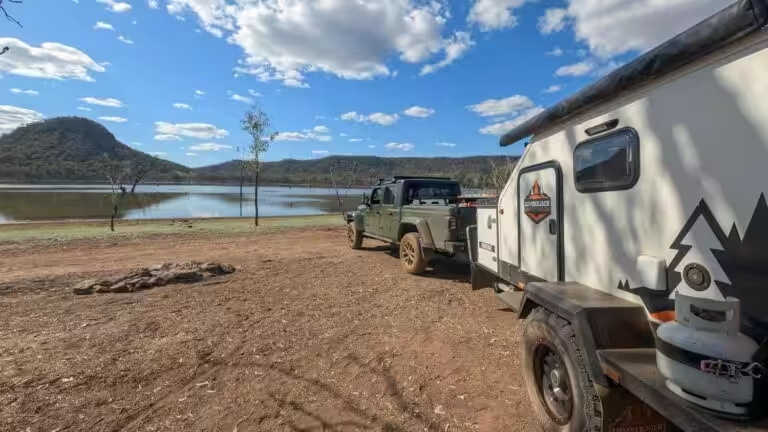
Bruder’s ADX-21 made its European debut at the show, bringing the Australian manufacturer’s approach to serious off-road touring to a European audience. This full-sized caravan features independent air suspension with up to 12 inches of travel and individual height adjustment, while the electrical system can be configured with up to 900Ah of battery capacity, 1600W of solar and a 3000W inverter. Prices start at around $189,990.
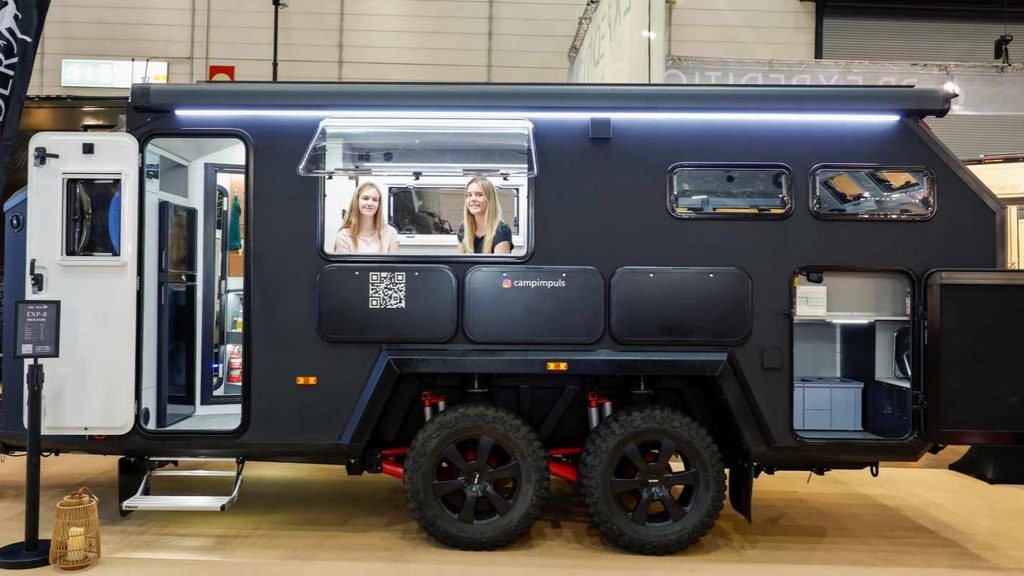
Sitting alongside it was Bruder’s EXP-8, which Messe Düsseldorf named the most expensive trailer at this year’s show at $343,000. Designed for expeditions into remote areas, it combines Bruder’s off-road suspension technology with a 48V electrical system and a luxury interior.
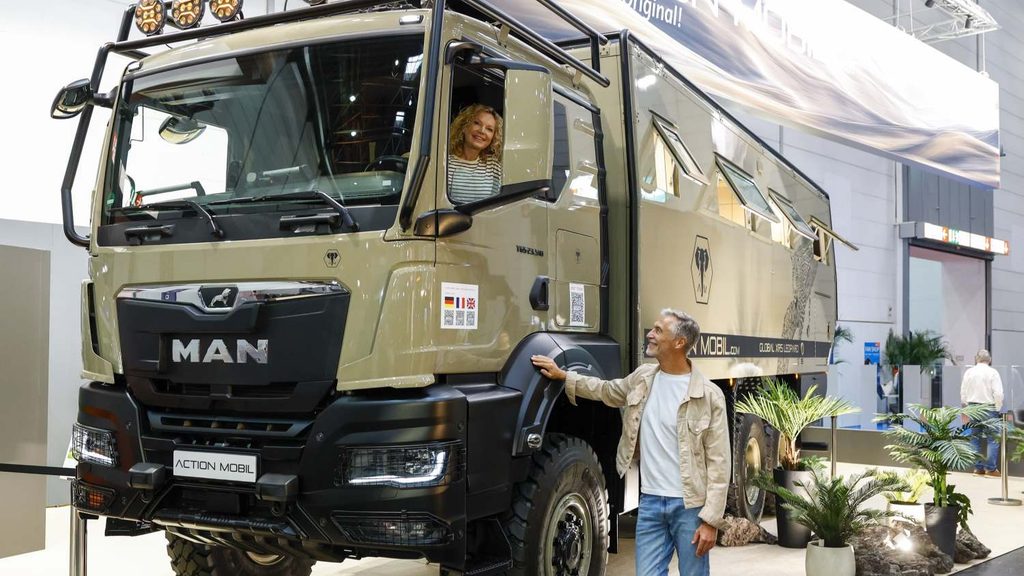
And Australia wasn’t alone in taking off-road touring to extremes. Austria’s Action Mobil debuted the Global XRS 7400 Leopard, a 10.5-metre expedition vehicle built on a MAN TGS 6×6 chassis. It carries up to 36kWh of battery capacity, 2.1kW of solar and 500 litres of fresh water, and even uses a closed-loop shower system to treat and reuse water. The price? More than $2.4 million.
Meanwhile, German expedition specialist Kerkamm unveiled a Ford Ranger 6×6 motorhome with sleeping space for four, 800Ah of lithium batteries and 260 litres of fresh water.
For Australian caravanners, big battery banks and serious off-road capability are hardly revolutionary. What’s good to see, is the same appetite for highly capable, self-sufficient expedition RVs playing out internationally and Australian manufacturers taking some of that technology back to Europe.
Most conversations about electric vehicles and caravanning tend to focus on one question: can an EV tow a caravan without destroying its driving range? Some of the concepts at Düsseldorf suggest the RV industry is starting to ask a different question: what if we designed the RV around electrification in the first place?
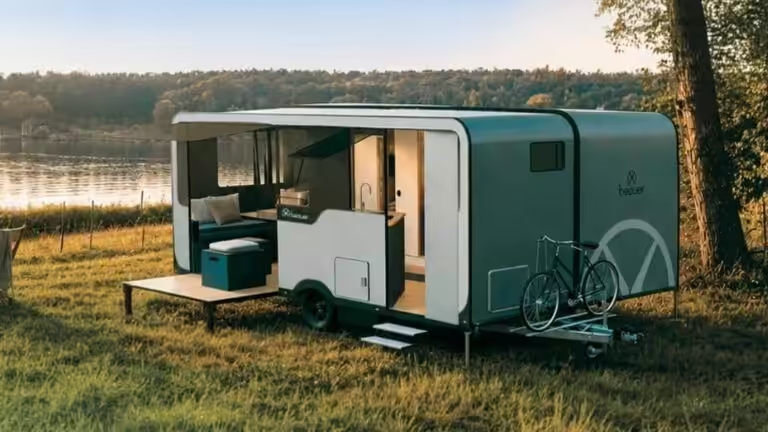
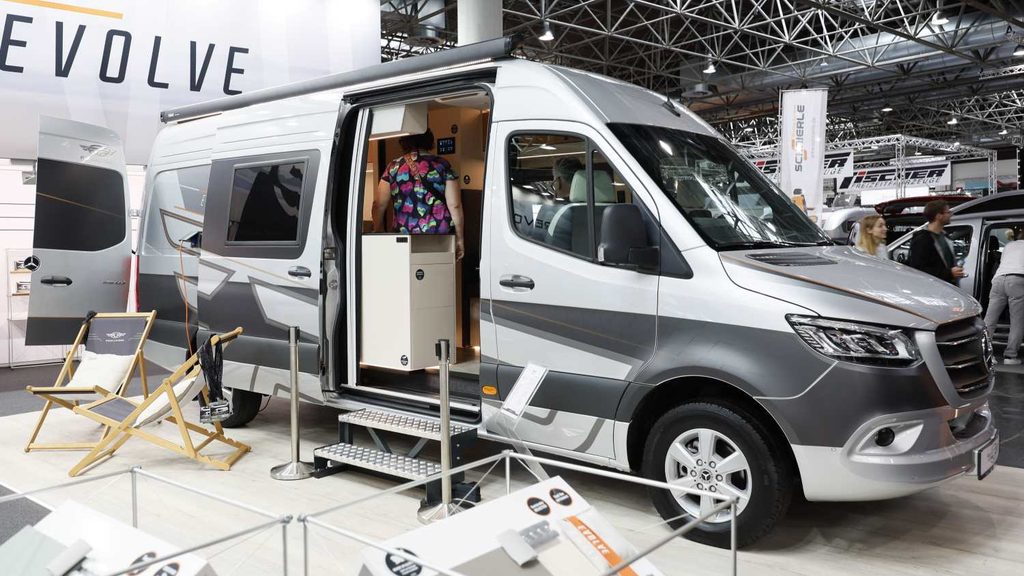
One of the show’s more interesting world premieres was the Evolve concept, developed by Vöhringer, Ross Design, Motive Development and North American startup CityFreighter.
Rather than converting an existing commercial van platform into an electric motorhome, Evolve sits on a purpose-built battery-electric skateboard platform. Integrating the battery, drivetrain and chassis into the floor creates a level interior and gives designers greater freedom over the layout.
Despite carrying a 128kWh battery as well as a bathroom, kitchen and heat pump, the concept weighs less than 3.5 tonnes and is claimed to offer more than 400km of range. It also supports 200kW fast charging, with a claimed 10-to-80 per cent charge time of around 20 minutes.
At the more conventional end, Eifelland showed an all-electric campervan based on the Nissan Interstar-e, while Sterckeman approached electrification from the other side of the towball. Its Mini Freestyle caravan is aimed specifically at EV owners, with a variable gross weight from just 750kg to 1200kg and a compact pop-top design intended to reduce aerodynamic drag.
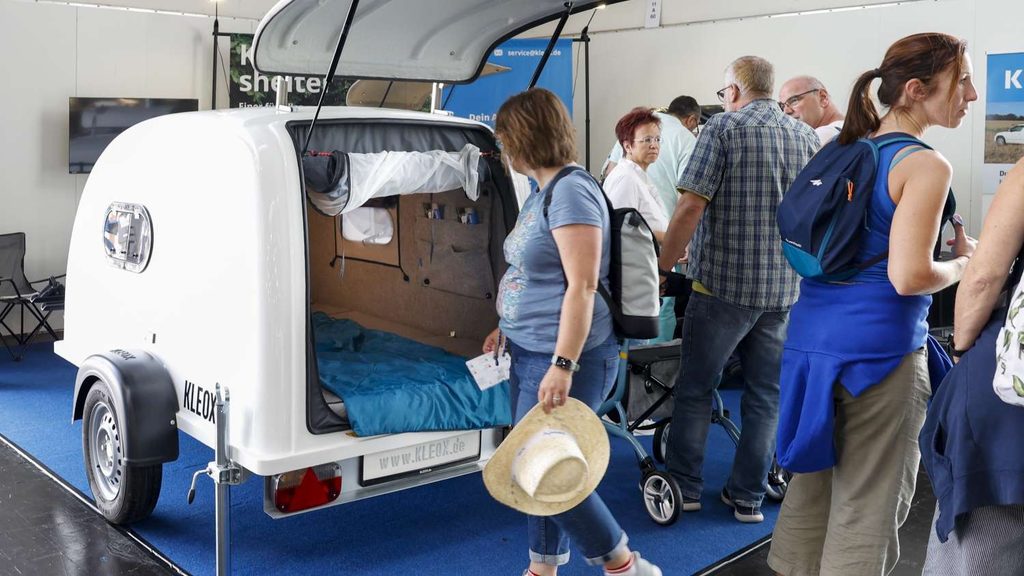
Then there’s the tiny Kleox teardrop camper. At only 220kg, it can be towed by small cars, EVs, ATVs and even vehicles such as the Smart.
None of this means the big Australian caravan is about to disappear. But as our choice of tow vehicles changes, caravan manufacturers may eventually have to think just as hard about reducing the demands of the thing being towed.
Space has always been one of the biggest compromises in RV design. Düsseldorf showed manufacturers getting increasingly creative about solving it.
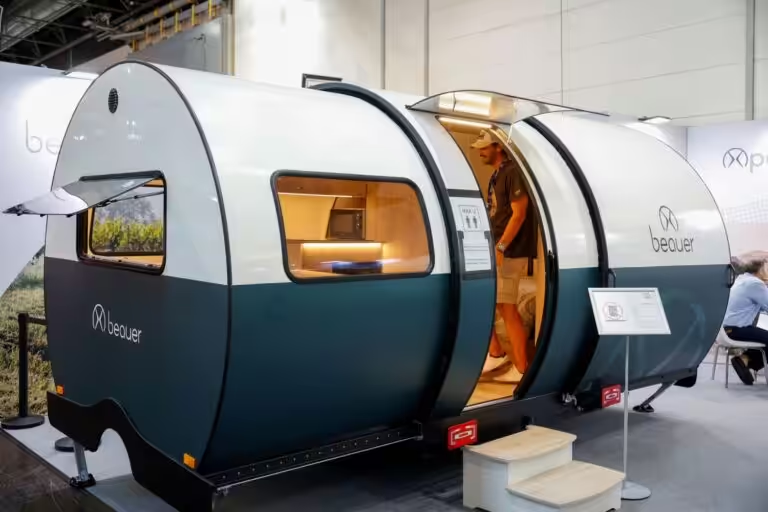
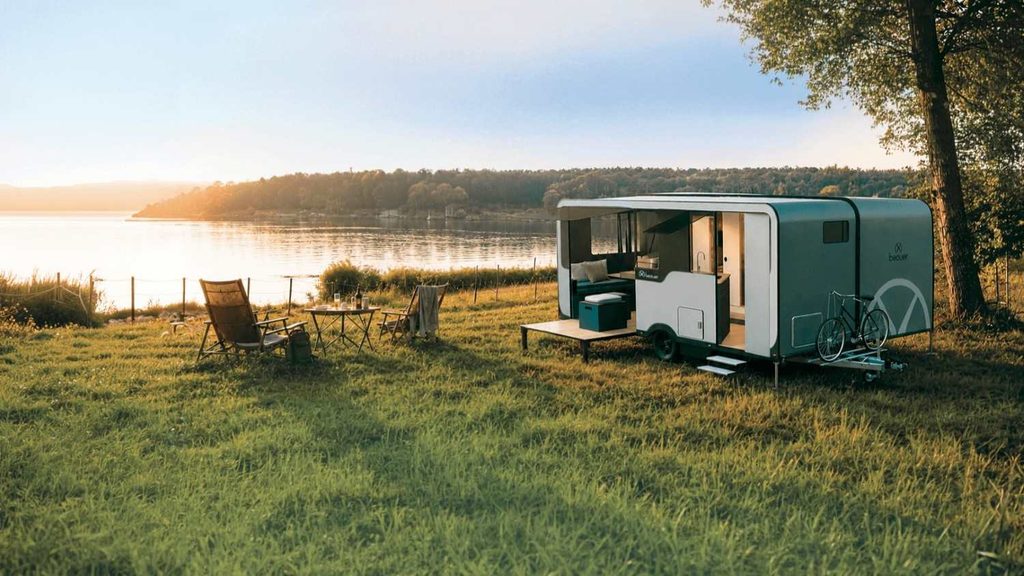
The most dramatic example is France’s Beauer X6. On the road, the X6 is 2.15 metres wide. Arrive at camp, press a button and its telescopic body electrically expands to a whopping 3.6 metres wide in around a minute. As the body expands, the bed and seating area lower automatically, creating around 20 square metres of interior space plus a 1.5-square-metre terrace. Despite its relatively compact travelling dimensions, there’s room for six people once set up.
Also featured on display was the Beauer X4, which expands more like a telescope.
Other manufacturers are making individual spaces perform multiple jobs.
The new Malibu relax 640 LE XR features electrically height-adjustable rear beds that can be raised all the way to the roof, creating a garage with up to 1.45 metres of loading height underneath. Rapido uses a similar idea in its 666 F, where the rear single beds can move vertically by 20cm depending on whether the owner wants more sleeping space or a larger garage.
Eura Mobil’s new Vancona campervans also offer electrically height-adjustable beds and removable storage, while LMC has raised the beds in its new Style 500 E caravan to create a large garage beneath.
Rather than simply making RVs longer and wider, manufacturers are finding ways for the same patch of floor space to do more than one job. Given the constant battle between living space, storage, weight and overall dimensions, that’s a trend with plenty of relevance here.
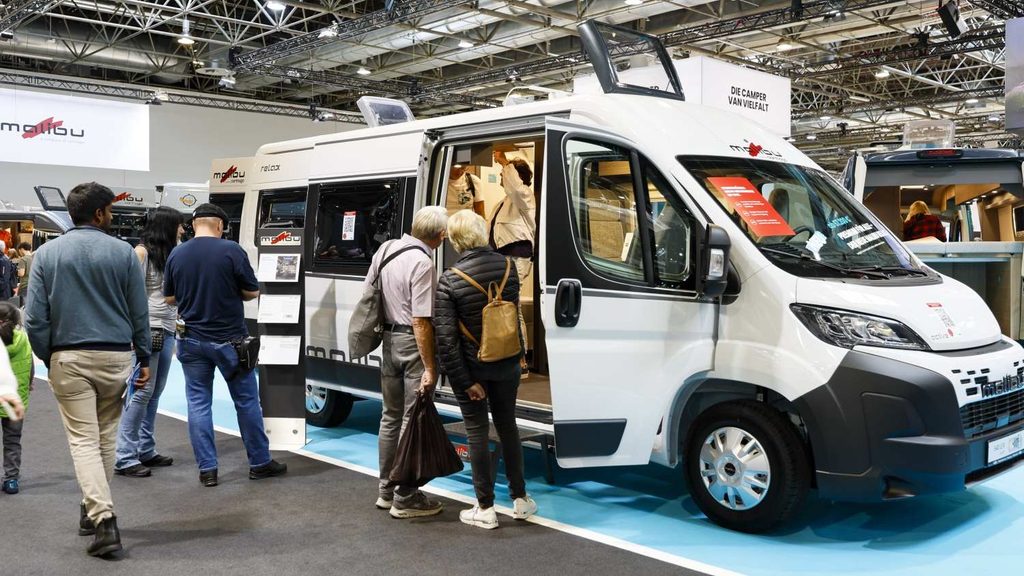
One concept at Düsseldorf wasn’t a new campervan at all. Volkswagen Commercial Vehicles and Stuff Bubble unveiled an inflatable camping kitchen and flexible bed system designed for the California Beach.
Both lightweight modules can be installed and removed in minutes, allowing the van to switch between everyday transport and camping duties without permanently carrying around a full camper conversion. Even more unusually, the kitchen and bed can be used independently inside or outside the vehicle.
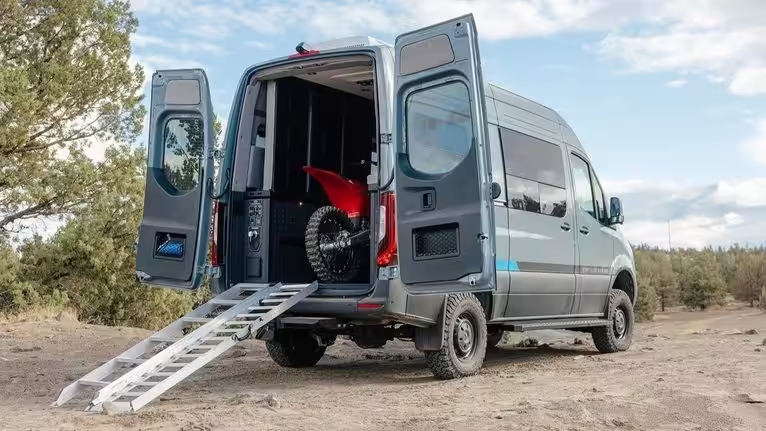
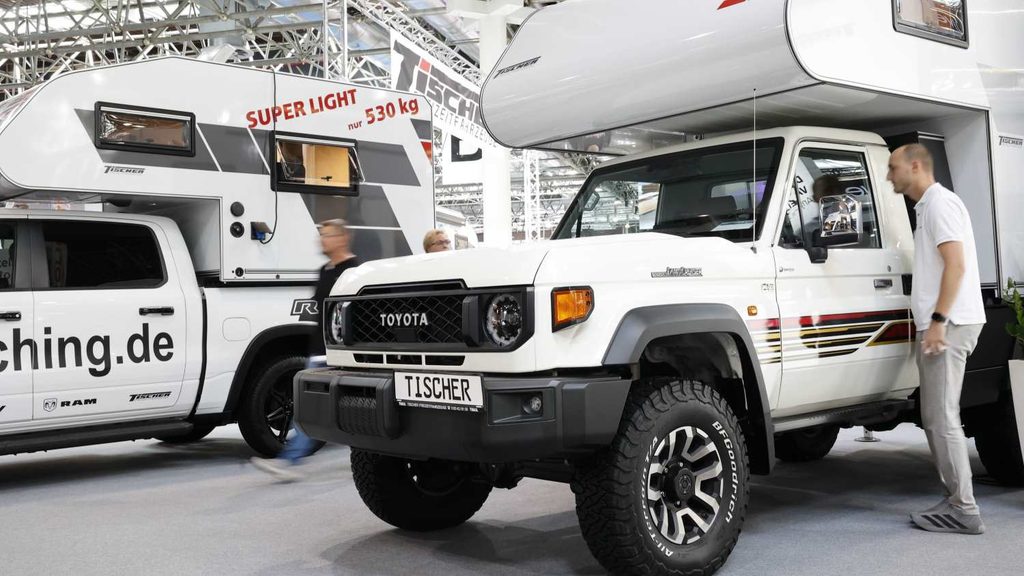
Tischer is tackling the same problem differently with removable pickup camper bodies. Its new combinations include a VW T7 with a Trail 280 S cabin, while a Toyota LandCruiser-based Box 260 SP can be configured with different seating, sleeping and storage arrangements.
For buyers who only camp on weekends or a few times a year, there’s plenty of appeal in being able to leave the camping gear behind and get your everyday vehicle back when the trip is over. It’s also an interesting counterpoint to the specialised and expensive touring rigs we see at the other end of the industry.
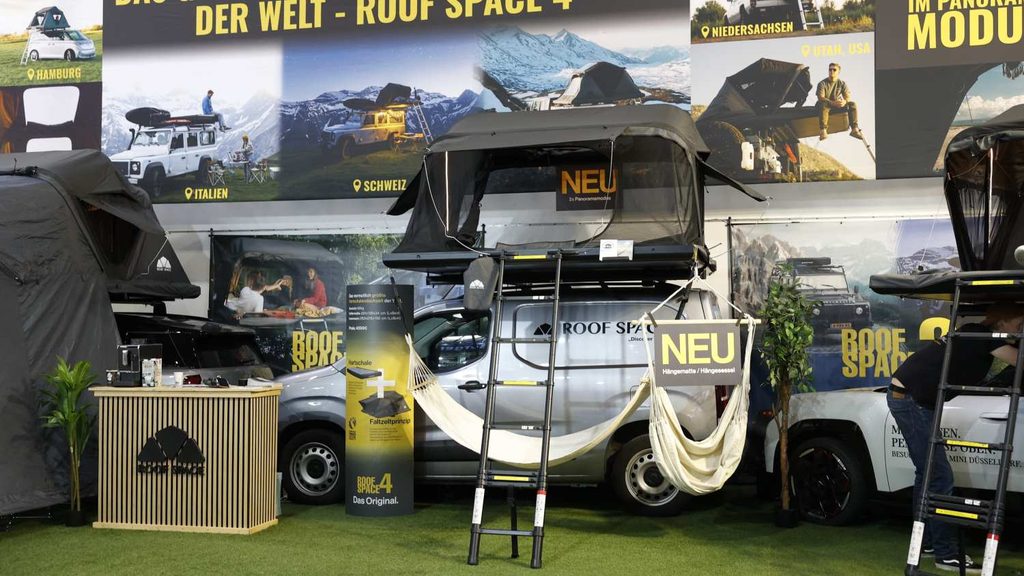
Roof top tents are ridiculously popular in Australia, but their basic premise hasn’t changed much. Put a tent on the roof and gain a quick place to sleep without towing anything behind you. The latest designs are becoming considerably more sophisticated and can sleep more people.
Germany’s Roof Space used Düsseldorf to show its new Roof Space 4, which combines the compact profile of a hard-shell rooftop tent with the extra room of a folding design. When packed away, it’s just 24cm high. Open it and there’s a 205 x 200cm sleeping area with room for up to four people. It also has something called Panorama Mode, which allows the entire front to open and effectively turns the tent into an elevated open-air terrace.
More interesting, however, is the company’s new Roof Tent Lift. A rooftop tent weighing around 90kg isn’t something most people can casually lift on and off the family 4WD. The new system can lift tents weighing up to 100kg onto vehicles as high as 2.3 metres and then doubles as a mobile storage rack once the tent comes back off.
It’s a simple idea, but one that addresses one of the biggest practical drawbacks of owning a rooftop tent: what do you do with the thing when you’re not camping? As the rooftop-tent market matures, innovations that make them easier to own may prove just as useful as finding elaborate ways to sleep in them.
Australian RV manufacturers have been heading towards bigger lithium battery banks and more solar for years, and Düsseldorf suggests the same transition is gathering pace overseas.
At the extreme end is the Action Mobil Global XRS 7400 Leopard, with up to 36kWh of battery capacity and 2.1kW of solar. Bruder’s ADX-21 can be fitted with up to 900Ah of battery capacity and 1600W of solar, while the EXP-8 steps up to a 48V electrical architecture. Kerkamm’s Ranger 6×6 carries four 200Ah lithium batteries and does away with gas altogether.
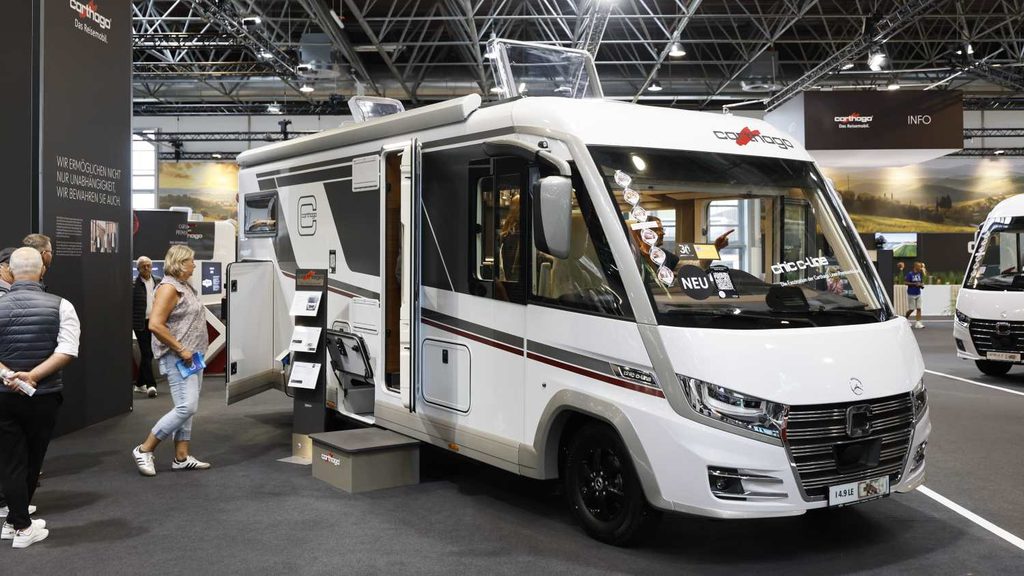
And gas-free systems aren’t restricted to rugged expedition vehicles. The extraordinarily luxurious VARIOmobil Perfect 1200 QS Platinum is also completely gas-free, while Carthago’s new premium Liner range combines improved self-sufficiency packages with digital onboard controls and options including a hybrid induction cooktop.
This isn’t simply about adding a larger battery so travellers can stay off-grid for another night. As electrical capacity increases, manufacturers can start removing other energy sources altogether and run more of the RV from a single system.
For Australian travellers who spend significant time away from powered caravan sites, that’s one overseas trend that already feels very familiar.
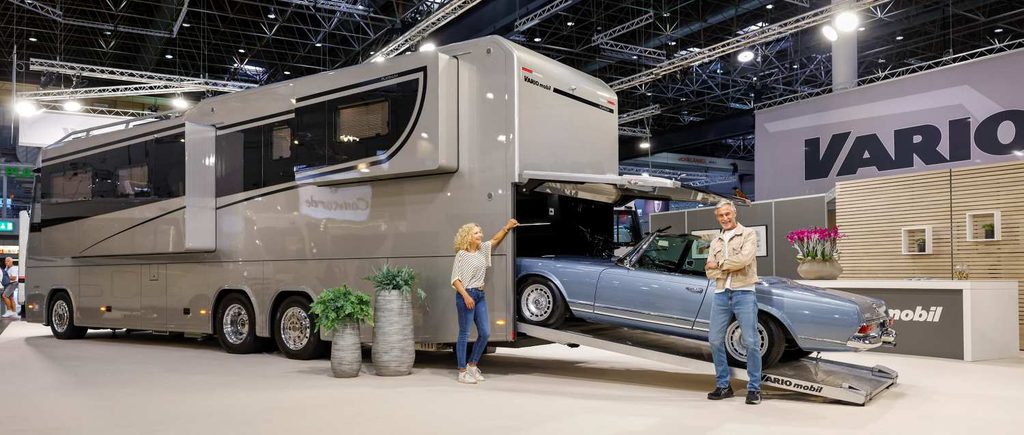
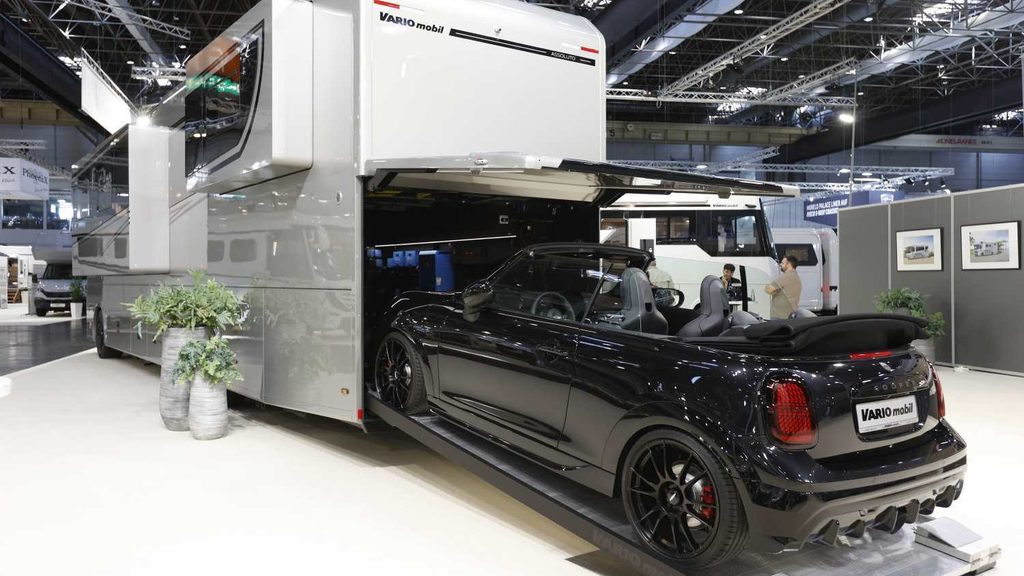
If lightweight caravans and inflatable kitchens show one possible future for RV travel, the VARIOmobil Perfect 1200 QS Platinum demonstrates the other. Calling it a motorhome almost feels inadequate.
Built on a three-axle Mercedes-Benz Actros, the Perfect is 12 metres long and uses four slide-outs to expand its interior into a 35-square-metre suite.
And then there’s the garage. Not a bike garage. Not somewhere to squeeze in a scooter. A car garage. The automated system can carry vehicles including a Maserati MC20, Mercedes-AMG Black Series or Porsche 911. The vehicle displayed at Düsseldorf was carrying a restored Mercedes SL Pagode.
The Perfect also features connected smart-home technology and an entirely gas-free system.
The downside? It costs €2.2 million (AUD $3.5 million). And somehow that’s not even the only seven-figure RV Messe Düsseldorf highlighted. The Action Mobil Global XRS 7400 Leopard comes in at more than €1.5 million (AUD $2.4 million).
Most of us probably aren’t wondering whether our next motorhome has enough garage space for the Porsche. But these halo models demonstrate just how far the RV market now stretches. At one end of the same show was a 220kg teardrop camper costing €6590 (AUD $10,634). At the other was a 26-tonne rolling apartment costing several million dollars.
If there’s one takeaway from Caravan Salon Düsseldorf 2026, it’s that there isn’t a single vision for the RV of the future. Some manufacturers are stripping away weight and complexity, building tiny caravans for smaller tow vehicles and modular campers that can return to everyday duties once the weekend is over.
Others are going in completely the opposite direction, with enormous battery systems, increasingly capable off-road vehicles and levels of luxury that would have seemed absurd in a motorhome not all that long ago. Between those two extremes, we’re seeing cleverer use of space, more electrification and a growing focus on making RVs more self-sufficient.
Australia is already ahead of the curve in some of those areas, particularly when it comes to off-road caravans and off-grid touring. The fact that Australian-built Bruder caravans were among the models highlighted at Düsseldorf is a reminder that ideas don’t only flow in one direction.
As for what comes next? Your future RV might be lighter, electric, modular and clever enough to transform at the push of a button. Or it might weigh 26 tonnes and have a Porsche in the back. Apparently, there’s room in the industry for both.