A remarkable fossil discovery near the Outback Queensland town of Richmond has given scientists a glimpse into life beneath Australia’s ancient inland sea, revealing the world’s first direct fossil evidence of a prehistoric marine predator chain.
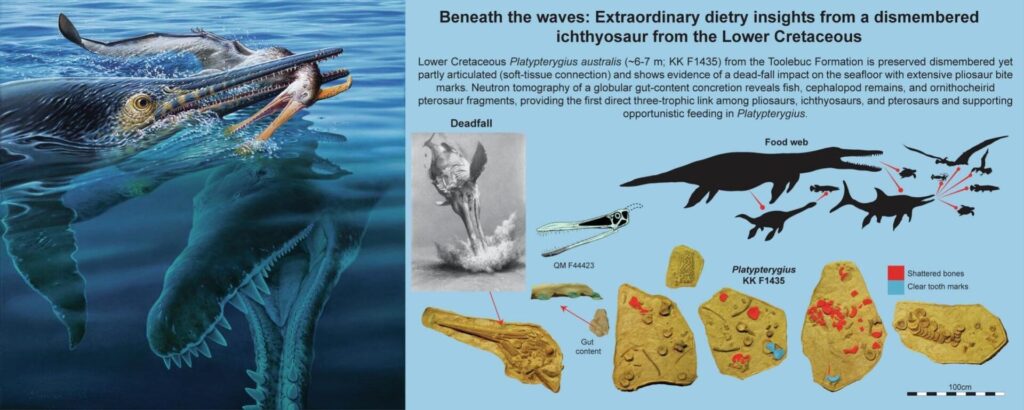
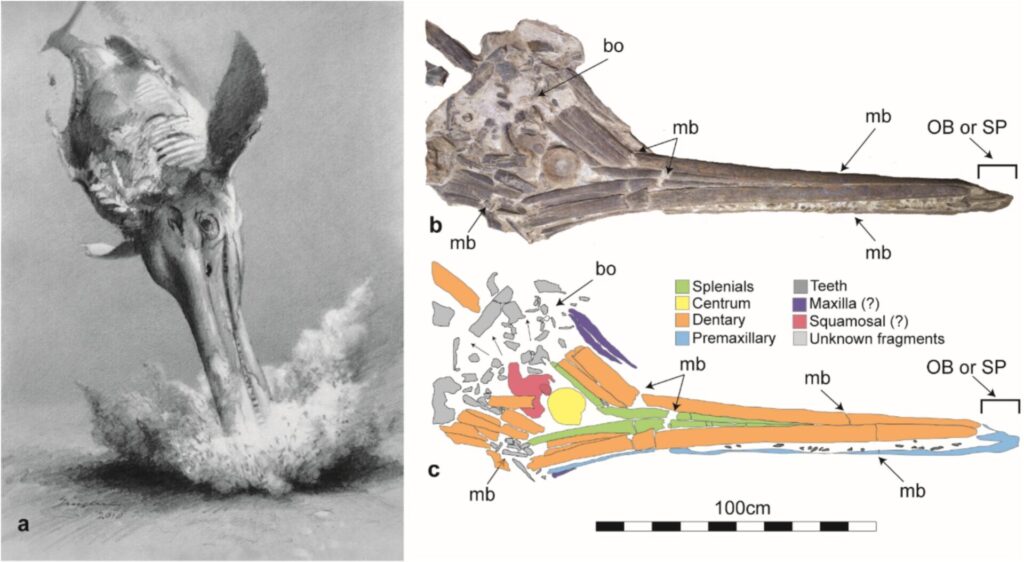
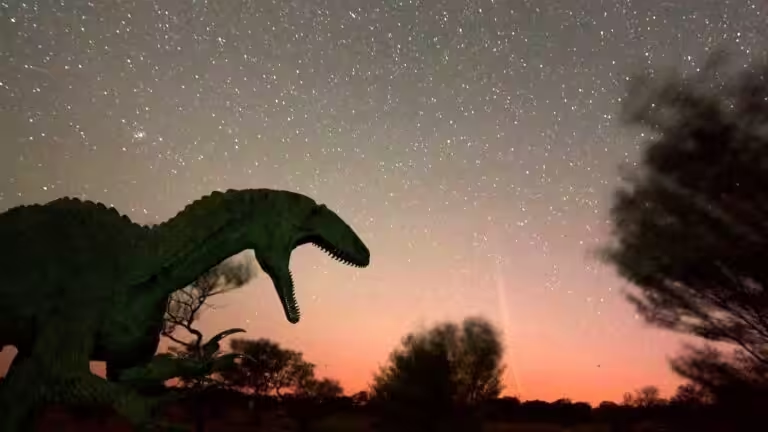
In what sounds like something you would expect to see in Jurassic Park, one explanation for the unique finding is that an ichthyosaur has leapt out of the ancient inland sea and snatched a low-flying pterosaur out of the air.
But wait there’s more.
They both have then become prey to a much larger predator, the Kronosauraus, who got lucky with a two-for-one meal.
The fossil belongs to a seven-metre-long ichthyosaur, a dolphin-shaped marine reptile that swam through the vast Eromanga Sea during the Early Cretaceous period, when much of inland Queensland was submerged beneath a shallow inland ocean.
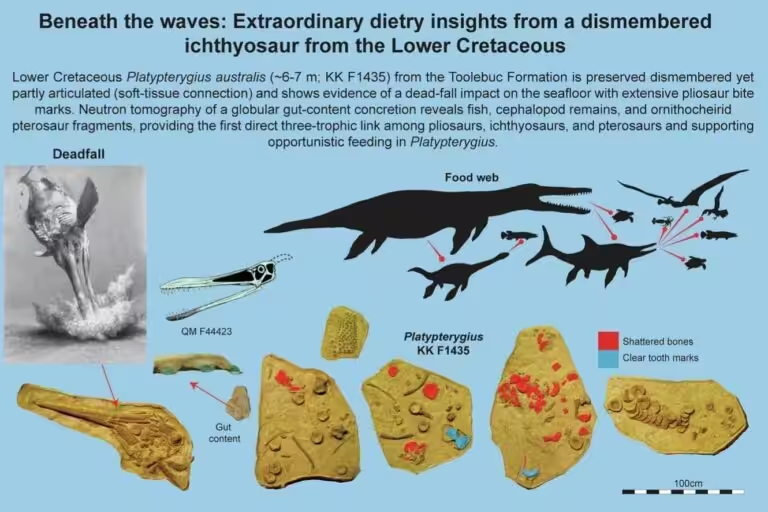
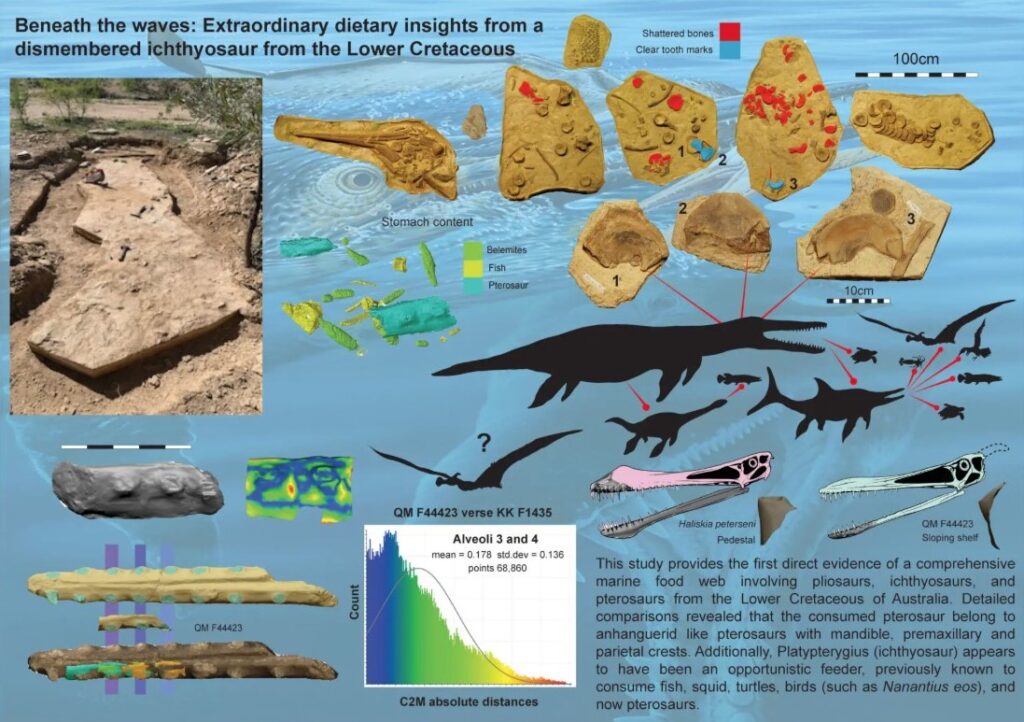
Using advanced synchrotron CT scanning at the Australian Synchrotron, scientists were able to peer inside the fossil without damaging it. Hidden within the ichthyosaur’s stomach were the remains of fish, squid-like cephalopods and, most remarkably, the jawbone of a flying pterosaur.
The discovery provides the world’s first direct fossil evidence that ichthyosaurs preyed on pterosaurs. But as mentioned earlier, the story doesn’t end there.
Large bite marks and crushed bones show the ichthyosaur itself was later attacked or scavenged by the giant pliosaur Kronosaurus queenslandicus – one of the largest marine predators to inhabit Australia’s ancient inland sea.
While fossilised bite marks and stomach contents have been found before, researchers say this specimen is unique because it preserves multiple levels of the ancient food web in a single animal.
Rather than simply revealing what prehistoric animals lived alongside one another, it offers direct evidence of how these marine predators interacted and hunted within the Eromanga Sea ecosystem.
The researchers say discoveries like this help paint a much clearer picture of life in Australia’s prehistoric oceans and the complex predator-prey relationships that existed millions of years before humans appeared.
Discovered by visitors
Perhaps even more remarkably, the fossil wasn’t initially discovered by scientists.
It was first spotted by visitors near Richmond in 2019 before being excavated by staff from Kronosaurus Korner Museum. After more than 600 hours of careful preparation, researchers noticed unusual nodules behind the skull, leading to the discovery hidden inside the fossil.
The findings were then confirmed using cutting-edge imaging technology before being published in the international scientific journal Gondwana Research.
Another reason to road trip through Outback Queensland
Richmond has long been recognised as one of Australia’s premier fossil destinations and forms part of Queensland’s famous Dinosaur Trail, alongside Hughenden and Winton.
Although the region is best known for its dinosaur discoveries, Richmond’s marine reptile fossils tell the story of a very different Queensland, one covered by an inland sea teeming with giant predators.
For RV travellers exploring Outback Queensland, this latest discovery is another reminder that some of Australia’s most extraordinary stories are still being uncovered beneath the dirt.
Whether you’re planning a lap of Australia or simply looking for another excuse to venture inland, Richmond continues to prove that the Outback is full of surprises, even if they are over 100 million years in the making.